


Published: February 5, 2026
Physical therapy practices face a fundamental engagement problem. Despite being one of the most effective and prescribed treatments in musculoskeletal care, only 25-35% of referred patients start therapy, and just 30% complete their care.
For many, the barriers are practical—long wait times, location constraints, scheduling conflicts, and recurring out-of-pocket costs. For others, the issue is accessibility. While virtual care has become more commonplace, it can be challenging for those with lower technical aptitude.
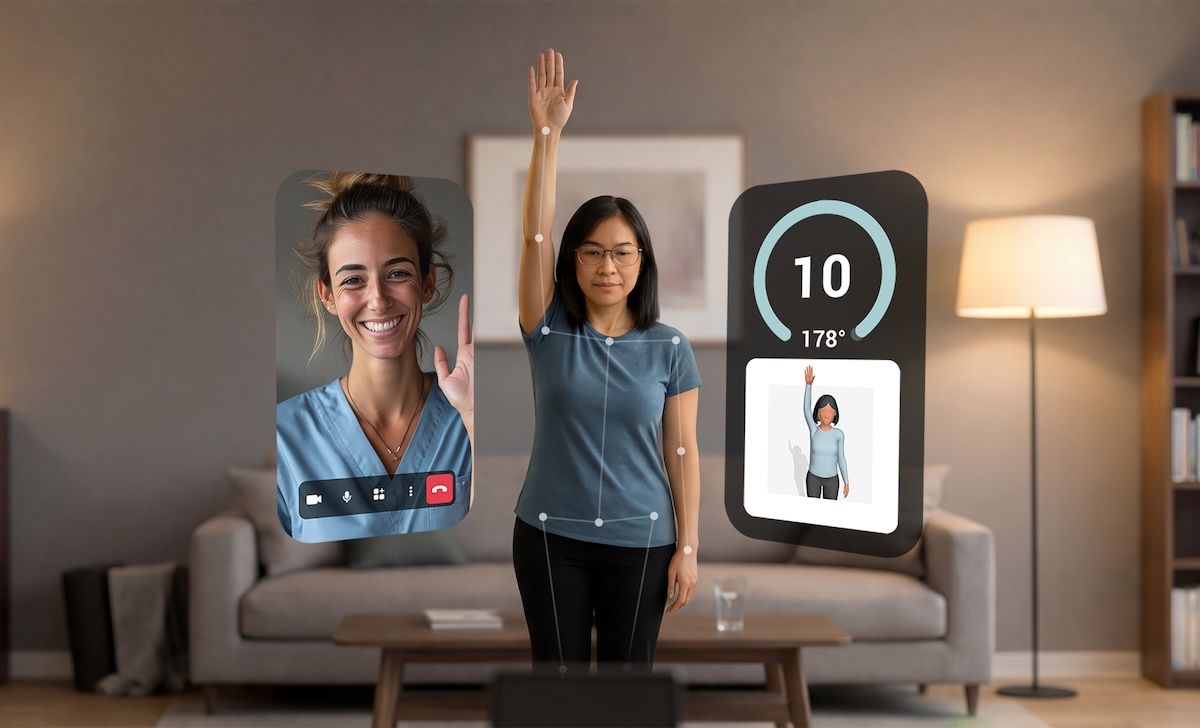
LainaHealth is a virtual physical therapy provider that uses a digital musculoskeletal (MSK) platform built to make physical therapy more accessible and cost-effective. We combine licensed therapists with our Live Artificial Intelligence Navigation Assistant (Laina). Under the instruction of licensed physical therapists, Laina delivers intelligent automation by training and deploying a custom model to the web that provides real-time motion analysis, personalized exercise progression, and conversational support.
Our challenge: An app for everyone
An acceptable solution has to treat a broad population effectively, so we needed it to be device-agnostic, frictionless, and accessible. We strove to build a platform that could work seamlessly for anyone, without requiring an app download. As we're a US-based company and physical therapy is a medical service, that also meant our application had to be medical-grade and HIPAA-compliant.
Before 2020, we found most digital solutions required dedicated hardware or app installations, which led to high friction for patients. We built prototypes that relied on additional external devices (such as tablets), and this introduced issues with shipping delays, network setup challenges, and added costs. Due to these factors, scaling our solution was near impossible.
We hypothesized that we'd improve patient engagement and outcomes if we built our application on the web. If we had no downloads and no technical setup, there would be significantly fewer barriers.
Our application would qualify as an FDA Class II web app that uses machine learning (ML) without special sensors or hardware, while still delivering real-time motion analysis. To ensure privacy, we knew we'd need on-device inference and secure, tokenized links. We decided to measure our success by how easily patients could access care, higher patient engagement, and lower cost per a course of treatment, or an episode.
Machine learning for personalized therapeutic support
We began by creating a proof-of-concept using the PoseNet model to evaluate if our idea was feasible. The initial results were promising, but the overall accuracy, and speed of the model weren't sufficient to launch. We then tried the MoveNet model, a pose-detection API in TensorFlow.js. While it improved the speed and accuracy, we hadn't achieved the same fidelity as models designed for dedicated hardware.
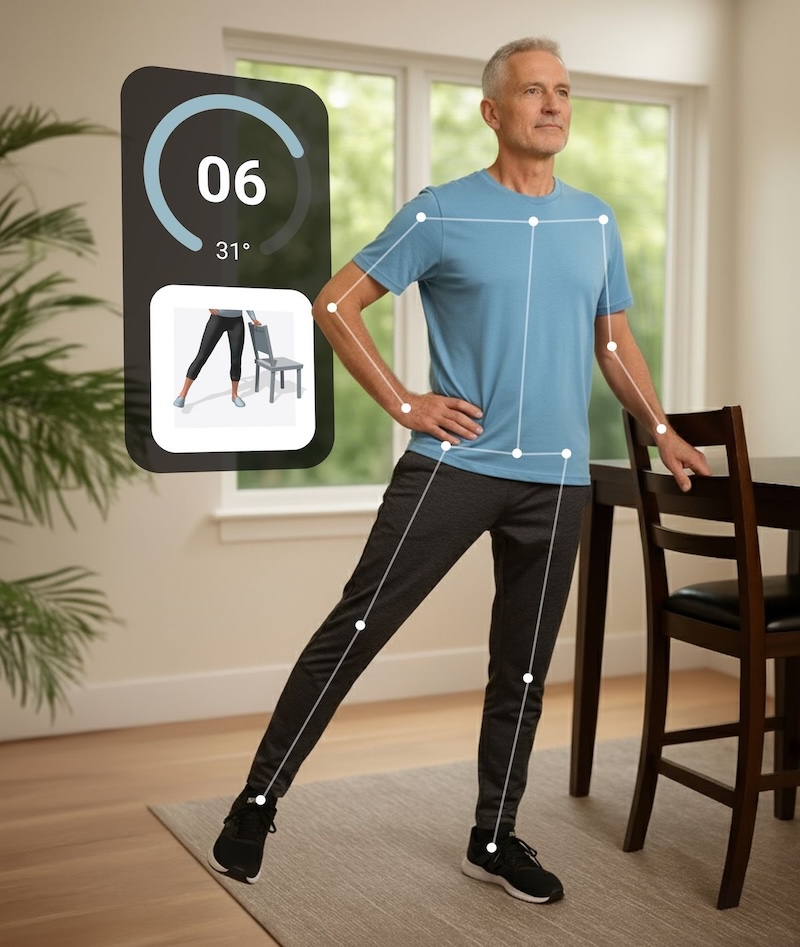
To overcome this roadblock, we collaborated with Google to fine-tune a subclass of the MoveNet, optimized specifically for musculoskeletal rehabilitation. We recorded and annotated hours of clinical movement data to train this subclass model, and the resulting analysis extended MoveNet's capabilities to recognize more than joint positions. MoveNet recognized motion patterns and compensations, which are critical for musculoskeletal therapy.
For HIPAA compliance and patient privacy, we needed the model to run its inference in the browser. This ensured protected health information, such as diagnosis and conditions in treatment, wouldn't be shared with third-party models or external providers.
So, we converted the custom model in TensorFlow.js. Last, we implemented a few other performance optimization tasks that focused on maintaining real-time inference speeds and minimal load times across devices.
Our first deployment in 2021 proved that the concept was possible, but the application wasn't device-agnostic. We still relied on specific Apple devices for processing. While the model had come a long way, the model still struggled with certain body positions, ankle tracking, and body rotation in a 3D space.
We tested with users and found that patients' confidence in the experience decreased when they noticed motion distortion and lag. Users started to notice this when the video output fell to fewer than 20 frames-per-second.
We tackled these problems by reducing the overall model load, introducing multiple, smaller models that worked together. Each small model was tuned for specific body regions and orientations. By late 2023, we produced a browser-based model that achieved near-device accuracy, capable of measuring motion velocity and range of motion, without specialized sensors. Since then, we can deliver medical-grade motion analysis through a single, secure web link.
We provide healthcare-grade physical therapy online, with zero setup or downloads.
Scaled engagement and reduced costs
By moving LainaHealth and our pose estimation system to the web, we scaled virtual physical therapy across 45 states, improved on patient engagement, and reduced costs:
74 %
Reduction in patient cost
2 x
Patient enrollment and completion rate
4 x
Engagement in physical therapy
- 2× higher patient enrollment, 2x higher completion rate and 4x engagement compared to traditional physical therapy.
- Average of 34 visits per completed episode, versus 8 in standard in-person care.
- 74% reduction in cost per episode through improved efficiency and scalability.
- Validated clinical outcomes, with objective adherence and functional improvement tracked with web AI.
In addition, LainaHealth's web app services patients ranging from 12 to 99, demonstrating that our web AI-driven approach works across diverse populations and technical abilities.
Conclusions and recommendations
Physical therapy has long faced a practical accessibility problem—patients struggle to attend sessions due to time, distance, and cost. By pairing web AI and licensed physical therapists, we significantly reduced those barriers and made recovery possible from the comfort of home.
We designed a model and application that delivered higher access, lower cost, and faster recovery, to help patients return to the lives they want to live. We've shown that intelligent, browser-based AI can enhance—not replace—human care, enabling a more personalized, scalable, and effective approach to musculoskeletal health.